
Pathogen safety: How plasma-derived medicinal products are kept safe
Ensuring the safety of plasma-derived medicinal products (PDMPs) requires a rigorous, multi-layered system designed to prevent the transmission of pathogens - microorganisms that can cause disease, including viruses, bacteria, and parasites. This system spans from donor selection, continues through plasma testing, and processing to final product release and is shaped by decades of scientific progress, regulatory oversight, and continuous innovation.
PDMPs are among the safest biological products in use today. There have been no reported cases of viral transmission through PDMPs for over 25 years - a direct result of the robust safety measures applied at every stage of the process.
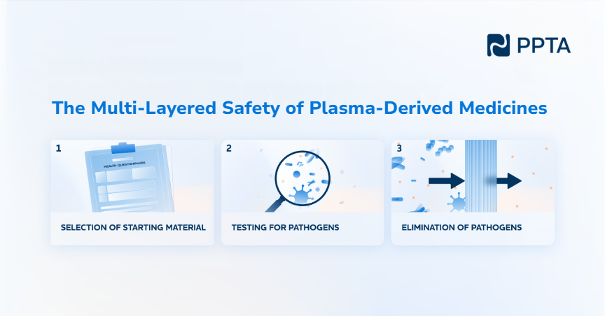
A Three-Pillar Approach to Pathogen Safety
1. Careful Donor Selection and Screening
The first line of defense is selecting healthy, low-risk donors. Before each donation:
Individuals must meet defined eligibility criteria (age, weight, general health)
A comprehensive health screening and physical exam is conducted
Blood is tested for key markers of infectious diseases (e.g. HIV, hepatitis B and hepatitis C)
Donors showing any risk indicators are temporarily or permanently deferred. All donations are traceable, enabling rapid follow-up and withdrawal if necessary.
2. Comprehensive Testing of Plasma
Plasma undergoes multiple rounds of testing before it enters manufacturing. This includes:
Serological tests for known viruses such as HIV, hepatitis B virus (HBV), and hepatitis C virus (HCV)
Nucleic acid amplification testing (NAT), which detects viral genetic material with high sensitivity.
NAT testing is carried out to detect relevant viruses such as hepatitis A virus (HAV), parvovirus B19, HIV, HBV, HCV.
Testing at both individual donation and pooled plasma levels.
Donations that do not meet safety criteria are excluded. No plasma enters production without passing these stringent checks.
3. Pathogen Inactivation and Removal in Manufacturing
The manufacturing process for PDMPs includes multiple proven pathogen inactivation and removal steps, collectively known as pathogen reduction steps, specifically designed to eliminate any remaining pathogens. These include heat treatment, solvent-detergent processing, low pH incubation, and nanofiltration. Additionally, the manufacturing process of PDMPs itself, which include several fractionation/purification steps, can also contribute to pathogen reduction.
Each of these pathogen reduction methods target different classes of viruses (enveloped and non-enveloped) and/or prion proteins. Together they offer various layers of protection. These processes are validated to achieve log reductions far beyond what is necessary for safety (the cumulative effect of inactivation or removal steps to the overall risk reduction is in the range of million-fold or higher).
Addressing Emerging Pathogens
The pathogen safety framework is also effective against new and emerging viruses. During recent outbreaks, such as Zika virus, hepatitis E, and SARS-CoV-2 (COVID-19), no transmissions were reported through PDMPs. Manufacturing processes are regularly reviewed and adapted to respond to evolving threats, supported by ongoing research and pharmacovigilance systems.
Oversight, Traceability, and Continuous Improvement
The safety of plasma-derived medicinal products is ensured through a combination of national and international regulatory frameworks, comprehensive quality systems, and ongoing collaboration with public health authorities. Each plasma donation and final product is fully traceable, enabling rapid response if any issue arises. Independent audits and inspections are regularly conducted to verify compliance with Good Manufacturing Practices and other safety standards. Safety data are continuously monitored and reported to the appropriate regulatory bodies, and industry-wide standards are developed in close coordination with public health agencies to reflect scientific advances and evolving risks.
Conclusion
The pathogen safety of plasma-derived medicinal products is the result of a deeply integrated system that combines science, regulation, and continuous improvement. From donor eligibility to advanced pathogen reduction techniques, every stage of the process is designed to protect the health of the patients who rely on these essential therapies.
This is not just a matter of testing at the end - it is safety by design, built into each step of the journey. The entire process of manufacturing donated plasma into a finished medicinal product can take up to a year, and involves extensive quality checks, reflecting the complexity and care required to deliver safe, effective treatments.
While no medical system can ever eliminate risk entirely, PDMPs are among the safest biological products available today. The combination of donor screening, viral testing, inactivation/removal methods, traceability, and global oversight has created a system that has prevented the transmission of known and unknown viruses for over 25 years, even in the face of emerging pathogens.
These safeguards are not static. They are constantly reviewed, adapted, and improved in response to scientific advances and real-world data. This commitment to transparency, vigilance, and innovation helps ensure that PDMPs will remain a reliable and safe option for patients well into the future.
Acknowledgment
This site was developed with the kind support of our knowledge partner Plasma Protein Therapeutic Association (PPTA). We thank PPTA for their contributions to evidence-based content and review.